
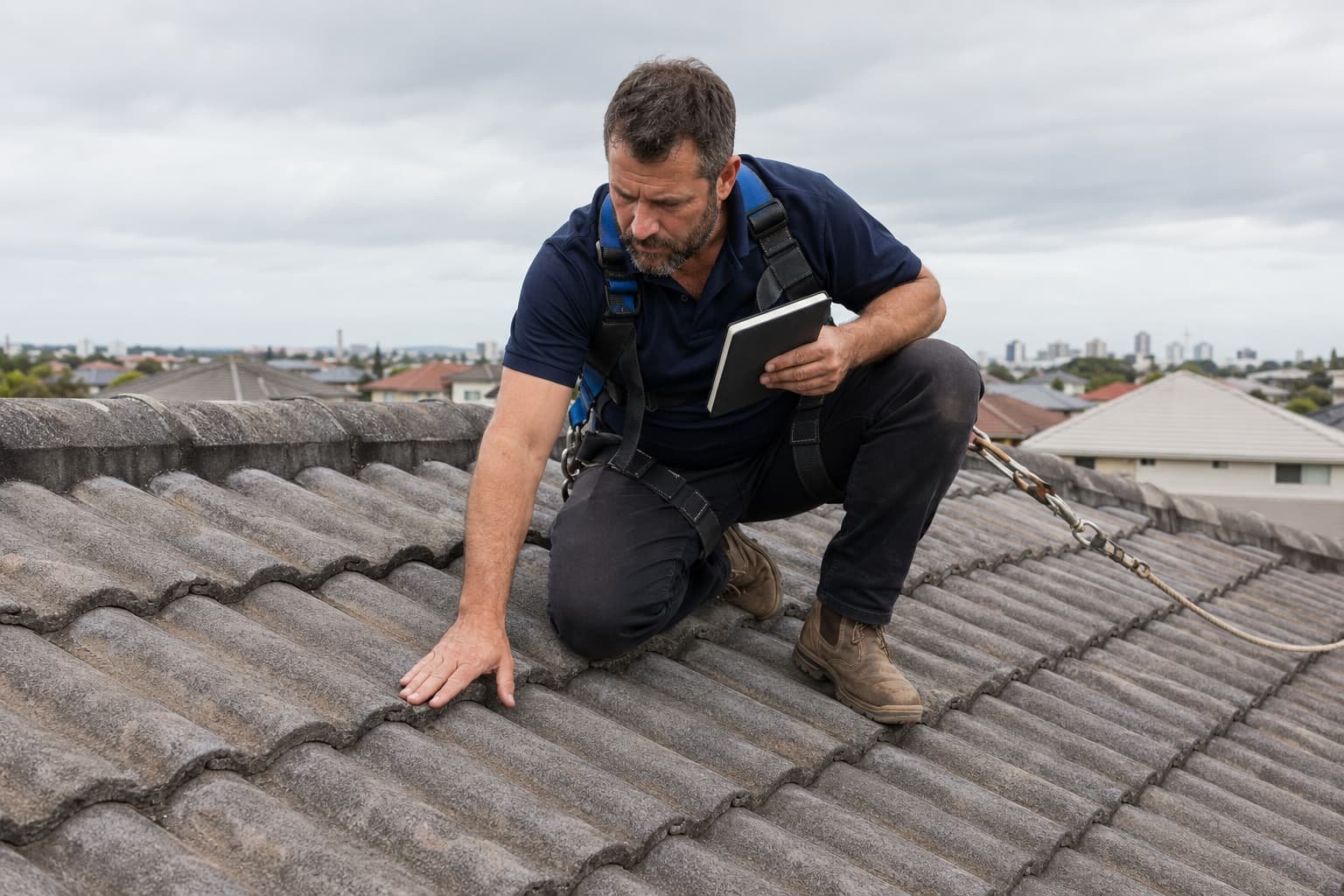
Roof Repairs in Nerang, Gold Coast
Roof repairs in Nerang are storm work more often than anywhere else on the Gold Coast. Nerang sits inland at the foot of the hinterland, directly in the path severe cells take as they build over the ranges through the afternoon and track east towards the coast. By the time a storm reaches the beaches it has usually already been through Nerang, and frequently at its strongest.
Our Roof Repair Services in Nerang
- Storm damage repairs — make-safe, tarping and permanent repair after hail and wind.
- Roof leak repairs — finding the entry point, not just the stain.
- Tile roof repairs — cracked and slipped tiles, re-bedding and repointing.
- Metal and Colorbond repairs — fasteners, flashings and sheet patching.
- Gutter, valley and downpipe repairs — the suburb’s most common recurring job.
- Roof restoration and repointing — for roofs now on their second maintenance cycle.
Why Nerang Roofs Fail
Hail is the first reason. Inland suburbs consistently take heavier hail than the coastal strip, because the cells are at their most energetic before they cross the last few kilometres to the water. Hail cracks concrete and terracotta tiles, sometimes visibly and often as hairline fractures that only start leaking two or three storms later.
Tree cover is the second. Nerang backs onto genuine bush, and the surrounding properties carry mature eucalypts, palms and long-established garden trees. The debris load in gutters and valleys here is heavier than anywhere on the coastal side of the motorway, and compacted leaf matter sitting in a valley iron holds water against the metal until it corrodes through.
Age is the third. Much of Nerang’s residential stock went up through the 1970s, 1980s and 1990s on brick and concrete tile, which puts thousands of roofs right at the point where bedding mortar has failed and ridge capping has started to move.
What Nerang has less of is salt. Being well back from the water, fixings and valley irons last appreciably longer here than they do at Southport or Burleigh, which changes the economics of repair against replacement on a metal roof.
Local Context
Nerang is one of the oldest settlements on the Gold Coast, established as a river town well before the coastal resorts existed, and it still functions as a service and administrative centre rather than a beachside suburb. The City of Gold Coast maintains an administration centre on Southport Nerang Road, the railway station on the Gold Coast line sits at the eastern edge, and the Pacific Motorway interchange makes it the main gateway between the coast and the hinterland.
West of the town the land climbs quickly towards the Nerang State Forest and on to Hinze Dam, and the housing changes with it — from conventional suburban blocks through to larger acreage properties with long driveways and heavy surrounding vegetation. Those properties see the worst of both the debris load and the wind exposure, and access for roof work takes more planning than a standard suburban job.
The Nerang River runs through the suburb, and the area has a well-documented flood history. Flood damage is a different problem to roof damage, but the two arrive in the same weather, and a roof that was marginal beforehand tends to fail in exactly the event that causes everything else.
Why Choose Us for Roof Repairs in Nerang
- We prioritise storm make-safe calls through the season, and Nerang is usually hit before the coast is.
- We inspect for hairline hail fractures rather than only the obviously broken tiles, because those are what leak in February.
- We are set up for acreage access on the western side, where a job is rarely a simple ladder off the driveway.
- Licensed work, with the licence number on the quote.
Serving Nerang and the Surrounding Area
We work Nerang and the surrounding hinterland-fringe suburbs, and cover the full city from Southport and Upper Coomera in the north through Robina to Mudgeeraba and the coastal strip at Burleigh Heads.
Wind classification matters more here than most homeowners realise. Fixing requirements for roofs are set by the wind region a property sits in, and the standards behind that are published by the Australian Building Codes Board. A repair done to the wrong fixing specification will lift again in the next serious gust.
If a storm has been through and you are not certain whether it did anything, that is worth an inspection. Hail damage that looks like nothing from the ground is the most common cause of leaks we attend three months later.