Metal and Colorbond Roof Repairs on the Gold Coast
Metal roof repairs are usually cheaper than homeowners fear, because a metal roof almost never fails across the whole sheet. It fails at the fixings, at the laps and at the flashings, and those are all repairable without touching the rest of the roof. A sheet that looks past it from the ground is often carrying nothing worse than eighty perished rubber washers.
Why Metal Roofs Fail Here
Salt is the dominant factor on the Gold Coast, and it travels a lot further inland than the beachfront suburbs. Airborne salt settles on the roof, sits in the pans and around the fixings, and accelerates corrosion anywhere the protective coating has been broken. Homes within a few kilometres of the water see it worst, but it reaches well past the highway.
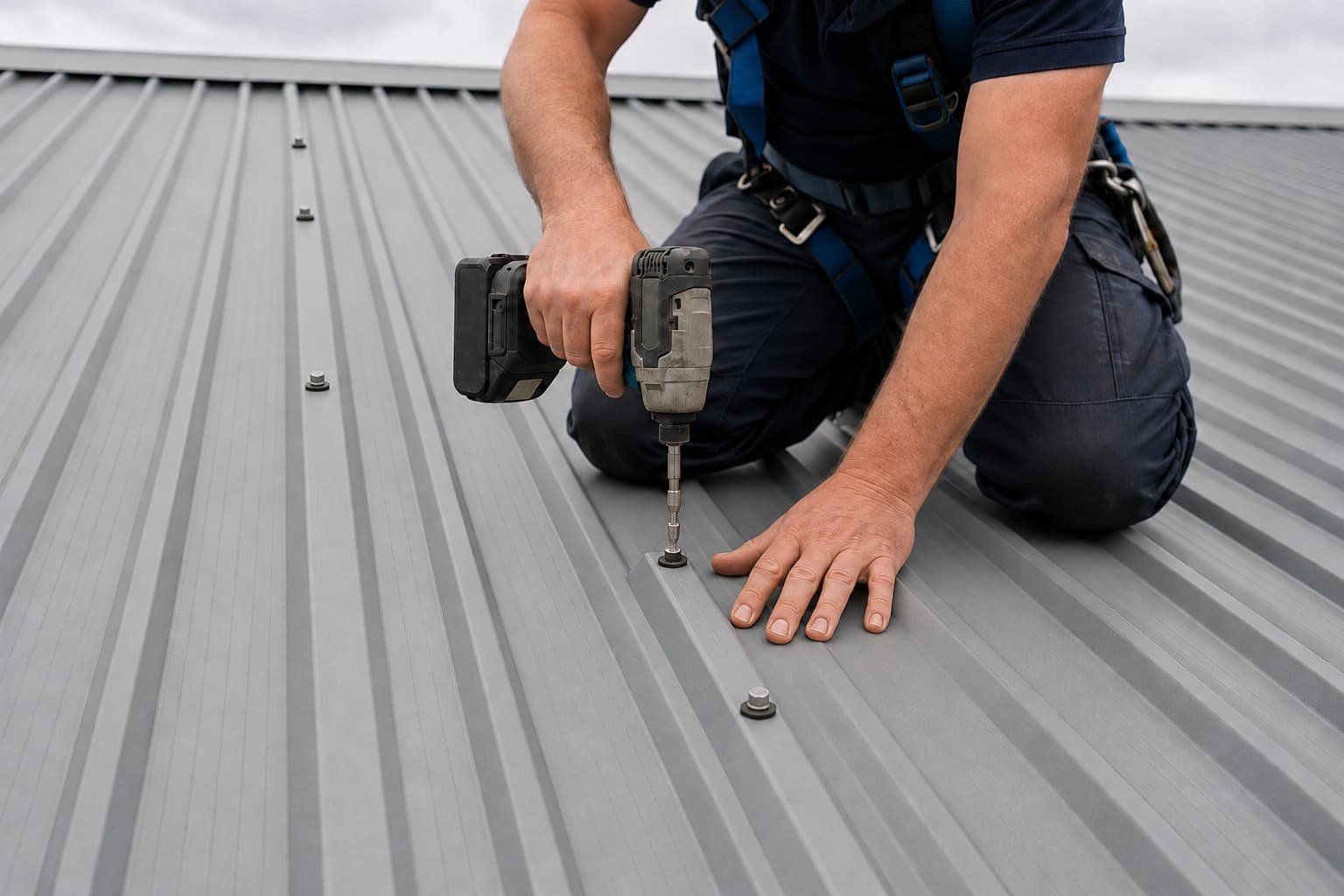
The screws go before the sheeting does. Roofing screws have a neoprene washer under the head that compresses to make the seal, and UV plus thermal cycling perishes that rubber in ten to fifteen years here. Once the washer has gone hard and cracked, every screw hole is an entry point, and a typical roof has thousands of them.
Thermal movement works everything loose. Sheeting expands and contracts significantly through a Queensland summer day, and that constant movement fatigues fixings, opens up laps and gradually lifts flashings at wall abutments and around penetrations.
Dissimilar metals cause trouble too. Where copper, lead or the wrong grade of fastener has been used against Zincalume or Colorbond, galvanic corrosion eats a hole through the sheeting from the point of contact outward, often surprisingly quickly.
What We Repair
- Fastener replacement. Perished washers and corroded screws replaced with correctly graded fixings, oversized where the original hole has elongated.
- Flashing repair and renewal. Wall abutments, ridge and barge flashings, and everything around penetrations, which is where most metal roof leaks actually originate.
- Lap and seam repairs. Sealing or re-fixing side and end laps that have opened up under thermal movement.
- Localised sheet replacement. Patching out corroded, holed or storm-damaged sections while matching profile and colour to the existing roof.
- Penetration resealing. Vents, flues, whirlybirds, solar mounts and skylight surrounds, all of which rely on a seal that has a finite life.
- Rust treatment. Cutting back and treating surface corrosion before it perforates, where the sheet still has serviceable life in it.
Repair or Replace
We will tell you honestly which one you are looking at. A roof with perished screws, a few corroded flashings and sound sheeting is a repair, and a straightforward one. A roof that has perforated in multiple locations, where the coating has failed broadly and rust is coming through from the underside, has reached the end of its service life and patching it is throwing money away.
The distinction matters because the two jobs sit an order of magnitude apart in cost. We would rather tell you at inspection that a repair is not the right answer than take payment for one that buys you eighteen months.
What Metal Roof Repairs Cost
Indicative and GST inclusive. Access, pitch and roof area drive the variance.
- Full fastener replacement: $1,500 to $4,000 on an average single-storey home, depending on roof area and screw count.
- Localised fixing and lap repairs: $350 to $900.
- Flashing renewal: $400 to $1,500 depending on length and junction type.
- Sheet replacement, patch area: $900 to $3,000, higher where the profile is discontinued and matching is difficult.
- Penetration reseal: $250 to $600 per penetration.
- Rust treatment and protective coating, localised: $600 to $2,000.
Frequently Asked Questions
Can you match my Colorbond colour?
In most cases yes. The current range is widely stocked, and even discontinued colours can usually be matched closely enough that a patch is not obvious once it has weathered. Older Zincalume and pre-painted sheeting can be harder, and we will tell you upfront if a patch will show.
How long do roofing screws last on the coast?
Ten to fifteen years for the washers in this climate, sometimes less on exposed coastal elevations. The screws themselves last longer if they were correctly graded for the location in the first place, which is not always the case on builder-grade estate housing.
My roof is noisy and moves at night. Is that a fault?
Usually not. Thermal ticking as sheeting cools is normal on metal roofs. Loud banging, or movement you can see, suggests fixings have loosened and is worth an inspection.
Is a dented roof after hail a problem?
Cosmetically yes, functionally often not. Dents matter when they distort the profile enough to break the seal at a lap or hold water in the pan. That is an inspection question rather than something you can judge from the ground.
Do metal roof repairs need a licensed contractor?
Roof plumbing is a licensed class in Queensland and building work above $3,300 must be carried out by a licensed contractor. Licences are searchable on the public register at the Queensland Building and Construction Commission.
Metal Roof Repairs Across the Gold Coast
Exposure varies sharply by suburb. Coastal homes at Burleigh Heads carry the heaviest salt load and lose fixings and flashings earliest. The newer estates at Upper Coomera are almost entirely Colorbond and are now old enough that builder-grade fixings are reaching the end of their washer life. Mixed older stock across Southport, Nerang, Mudgeeraba and Robina often has metal over patios, extensions and carports abutting a tiled main roof, and that junction is a frequent leak point.
If what you have is not purely a metal problem, we will scope the rest of it: roof leak repairs where the entry point is elsewhere, storm damage repairs after hail or wind, tile roof repairs where the two roof types meet, or gutter and valley work where corrosion has started at the roof edge.