
Gutter, Valley and Downpipe Repairs on the Gold Coast
Gutter repairs are the cheapest roofing work you will ever pay for and the most expensive to keep putting off. Water that cannot get away from a roof does not politely wait. It backs up over the flashing line, runs down inside the wall cavity, rots fascia and soffit timbers, and ends up in the ceiling from a defect that would have cost a few hundred dollars to fix.
Roof Plumbing Is Its Own Trade
In Queensland, roof plumbing is a separate licensed class from roof tiling, and for good reason. Gutters, valleys, downpipes, flashings and rainheads are a drainage system with sizing rules behind it, not trim. Getting the falls wrong, undersizing a downpipe or fitting the wrong valley profile causes failures that look like roof leaks and get misdiagnosed as such for years.
That distinction matters when you are choosing who to put on your roof. A tiler can reset your tiles beautifully and still leave you with a drainage system that overflows in the first serious downpour.
What Fails, and Why
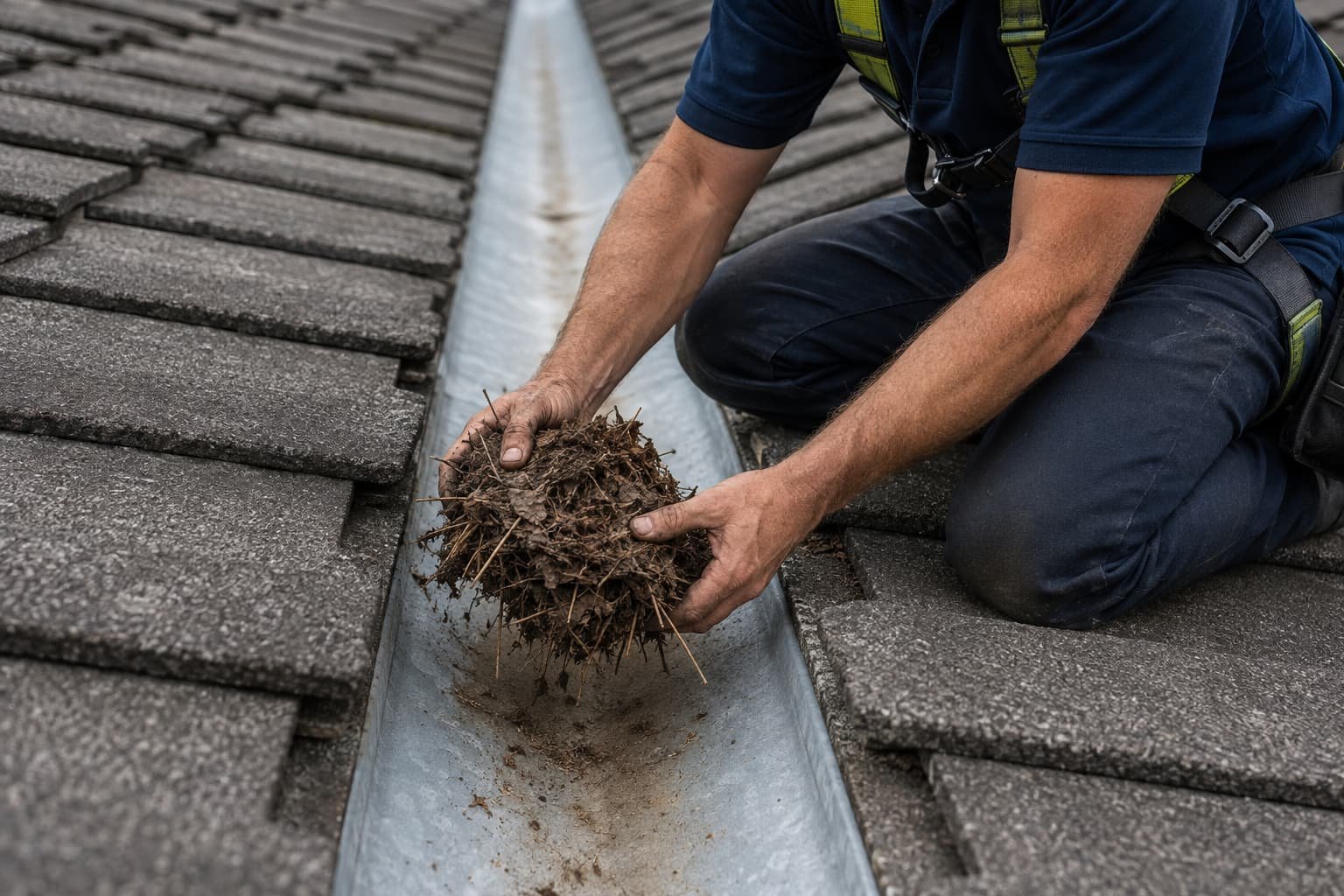
- Valley irons. The metal channel between two roof planes carries more water than any other part of the roof. Debris sits in it, holds moisture against the metal, and it corrodes through from the inside. Coastal salt accelerates this considerably.
- Rust at the gutter base. Standing water from poor falls or blockages eats the lowest point of the gutter first, usually at a joint or behind a bracket where it is invisible from the ground.
- Undersized or blocked downpipes. A downpipe that cannot clear the volume a Gold Coast storm delivers turns the gutter into a reservoir, and the overflow goes backwards under the roof edge.
- Failed joints and seals. Silicone at gutter joints and stop ends has a finite life under UV, and leaking joints drip onto fascia and eaves rather than into the downpipe.
- Sagging and incorrect falls. Brackets pull loose, gutters sag between them, water pools in the low spots and corrosion starts there.
- Fascia and eave damage. The downstream consequence of all of the above, and the point where a cheap repair becomes carpentry.
Debris Is the Root Cause Here
Subtropical vegetation sheds year round. Gum leaves, palm fronds, bottlebrush and jacaranda debris fill valleys and gutters faster than most homeowners expect, and the material compacts into a dense mat that holds water permanently against the metal underneath.
On hinterland-side suburbs backing onto bush, twice-yearly clearing is realistic. Closer to the coast with less tree cover, once a year usually suffices. Either way, the clearing wants doing before storm season rather than after it, because a blocked valley during a February downpour is how ceilings get wet.
What We Do
Clearing and inspection, valley iron replacement including lifting and resetting tiles either side, gutter section replacement, joint and stop-end resealing, downpipe replacement and re-sizing where the existing one is inadequate, bracket and fall correction, rainhead and overflow provision where the system needs it, and fascia repairs where water has already got into the timber.
We photograph what we find. Valleys and gutter bases are invisible from the ground, and you should be able to see the defect you are paying to fix.
What Gutter Repairs Cost
Indicative and GST inclusive.
- Gutter and valley clearing, single-storey: $250 to $500 depending on roof size and debris volume.
- Valley iron replacement: $1,200 to $3,500 per valley, including tile lifting and resetting.
- Gutter section replacement: $60 to $120 per metre supplied and fitted.
- Joint and stop-end resealing: $200 to $500 for a typical run.
- Downpipe replacement: $250 to $600 each, more where it needs re-routing or upsizing.
- Bracket and fall correction: $300 to $900 per run.
- Fascia repair: quoted per job once the extent of the timber damage is exposed.
Frequently Asked Questions
My gutters overflow in heavy rain but look clear. Why?
Usually downpipe capacity rather than blockage. A system sized for average rainfall will overflow under the intensities a severe storm cell delivers here, and the fix is more or larger downpipes, or a rainhead with proper overflow, rather than another clean.
Are gutter guards worth it?
Selectively. Good mesh keeps leaves out where you have heavy tree cover and are otherwise clearing twice a year. Cheap guard traps fine debris on top and creates a mat that is worse than an open gutter, and some products void roof warranties. It is a per-house decision.
How do I know if a valley has gone?
Generally you do not, until it leaks. Valleys are the highest-flow, lowest-visibility part of the roof, which is why they are on the inspection list every time we are up there.
Can rusted gutters be repaired or do they need replacing?
Isolated rust at a joint can be cut out and a section replaced. Where corrosion runs the length of a gutter, replacing the run costs little more than repeated patching and lasts decades.
Does this work need a licensed contractor?
Roof plumbing is a licensed class and work above $3,300 requires a licensed contractor in Queensland. Check any licence number on the register at the Queensland Building and Construction Commission.
Gutter Repairs Across the Gold Coast
Debris load varies enormously by suburb. Hinterland-side homes at Mudgeeraba and Nerang back onto heavy tree cover and fill valleys fastest. Coastal properties at Burleigh Heads carry less debris but lose valley irons and gutter bases to salt corrosion sooner. Older Southport stock frequently has original galvanised systems well past their life, while newer estates at Robina and Upper Coomera more often have capacity problems than corrosion ones.
Drainage problems rarely arrive alone. Where water has already been getting in, we will scope roof leak repairs, storm damage repairs if a recent cell caused it, tile roof repairs where lifting tiles has exposed further defects, metal and Colorbond repairs at the roof edge, or restoration and repointing if the roof is old enough to warrant doing everything at once.