
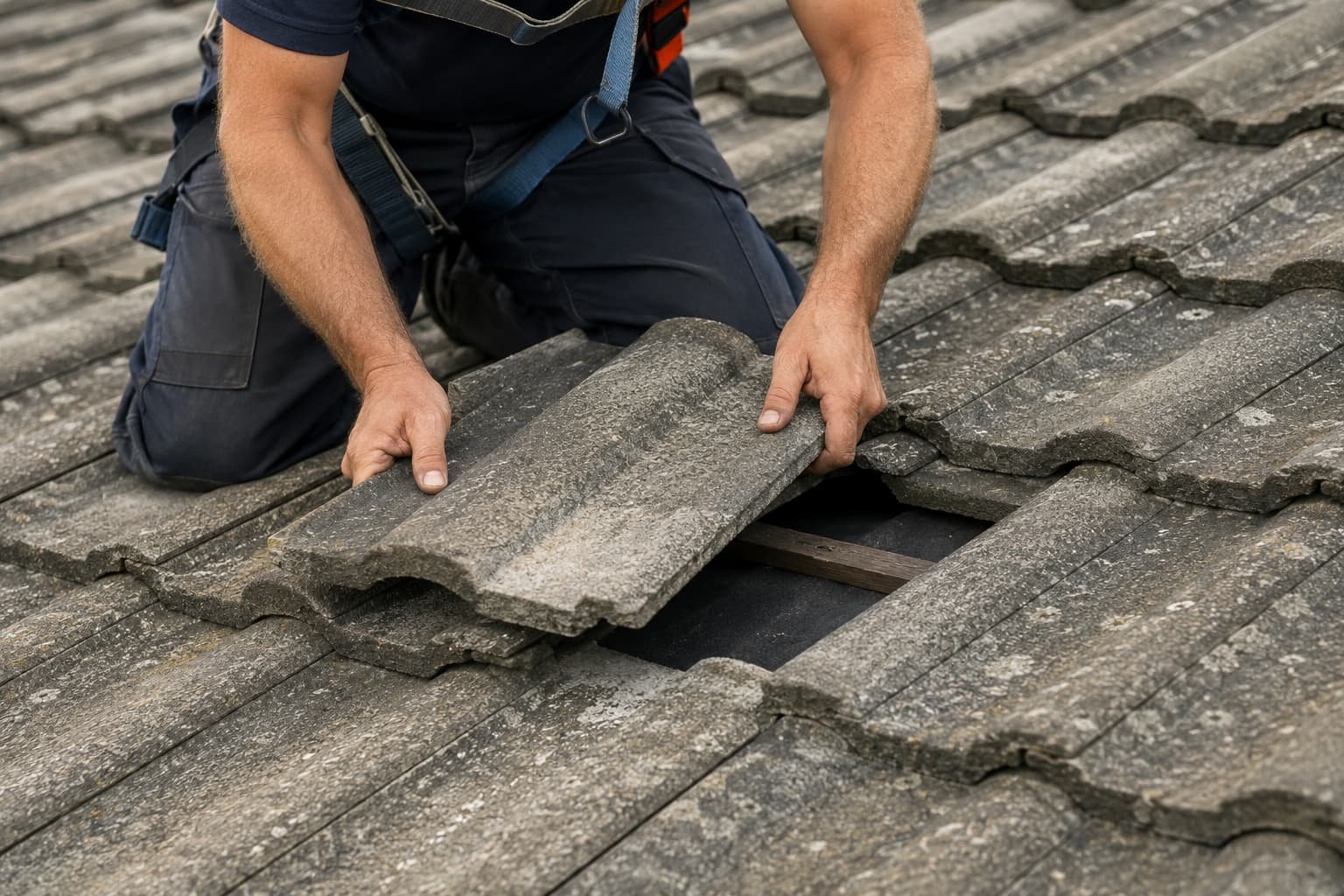
Tile Roof Repairs on the Gold Coast
Tile roof repairs are the bread and butter of roofing work on the Gold Coast, because tile is what most of the city is roofed with. Concrete tile went onto the great majority of homes built here through the 1970s, 1980s and 1990s, and terracotta covers much of the older and higher-end stock. Both last decades. What does not last decades is the mortar holding the ridge capping on, and that is where most tile roof problems begin.
Concrete and Terracotta Behave Differently
Concrete tiles are heavier, cheaper to replace and go porous with age. The surface coating wears off after twenty to thirty years, at which point the tile starts absorbing water rather than shedding it, grows lichen and moss, and gets appreciably heavier when wet. They crack cleanly under impact, which makes hail damage relatively easy to spot.
Terracotta is fired clay and does not go porous in the same way. A sound terracotta tile can outlast the house. What terracotta does do is become brittle, so it fractures under foot traffic and under hail more readily than concrete, and it is far less forgiving of anyone walking the roof without knowing where to place their weight. Matching discontinued terracotta profiles is also genuinely difficult, which is why we hold and source salvaged stock rather than telling you the whole roof needs replacing.
What Actually Fails on a Tiled Roof
Rarely the tiles themselves. In order of how often we find it:
- Bedding and pointing on ridge capping. The mortar bed cracks, the flexible pointing over it perishes, and capping starts moving. This is the single most common defect on Gold Coast tiled roofs and the most common source of leaks.
- Cracked and slipped tiles. Usually from hail, foot traffic, falling branches, or a tile that was never seated properly during a previous repair.
- Valley irons. The metal channel where two roof planes meet corrodes and perforates, particularly near the coast, and particularly where debris has been sitting in it holding moisture against the metal.
- Sarking. Older homes were built without it. Where it exists, it perishes and tears, and once it is gone the tiles are the only barrier between weather and ceiling.
- Flashings at penetrations. Around vents, flues, skylights and wall abutments, where sealant has failed or the flashing has lifted.
Our Repair Approach
We replace like with like wherever we can. That means sourcing a matching tile in profile and colour rather than dropping in whatever is nearest, because a patchwork roof is visible from the street and costs you at resale.
Bedding and pointing get done properly or not at all. The failure mode we see most often on other people’s repair work is fresh pointing smeared over old cracked bedding, which looks fine for a season and then moves again. If the bed underneath has gone, it comes off and gets re-bedded before repointing. Flexible pointing compound, not sand and cement, because the roof moves and rigid mortar cracks.
We also walk the whole roof while we are up there. Tiles are commonly broken by whoever was on the roof last, including previous tradespeople, and finding three cracked tiles above a bathroom before they leak is worth considerably more than the ten minutes it takes.
What Tile Roof Repairs Cost
Indicative and GST inclusive. Access and pitch move these figures more than anything else.
- Replacing individual broken tiles: $350 to $900 for a small localised area, subject to matching.
- Localised re-bed and repoint: $600 to $1,500 for one section of capping.
- Full ridge re-bed and repoint: $1,800 to $4,500 on an average single-storey home.
- Valley iron replacement: $1,200 to $3,500 per valley, including lifting and resetting tiles either side.
- Flashing repair or renewal: $400 to $1,500 depending on the junction.
- Sarking replacement: quoted per job, as it requires tiles to be lifted in sections.
Frequently Asked Questions
Can you match my tiles if the profile is discontinued?
Usually yes. Salvaged stock covers most Australian profiles from the last fifty years, and colour differences on weathered roofs are far less noticeable than homeowners expect once the tile has been up for a season. Where an exact match genuinely does not exist, we take tiles from a hidden elevation and put the mismatched ones there.
How long does bedding and pointing last?
Bedding mortar typically gives fifteen to twenty-five years here. Flexible pointing over a sound bed lasts longer than rigid mortar and is what current practice calls for.
Is a cracked tile urgent?
On a sarked roof, not immediately, but it will leak eventually. On an unsarked roof, which describes a lot of pre-1980s Gold Coast housing, a cracked tile is a direct path into the ceiling and should be dealt with before the next storm.
Should I get the roof pressure cleaned?
Carefully, and not as a matter of routine. High pressure strips the remaining surface coating from aged concrete tiles, drives water up under laps, and is a common cause of leaks appearing shortly after a clean. It has its place as part of a restoration, not as a standalone service.
Is my repair covered by any warranty?
Queensland requires licensed contractors for building work above $3,300, and statutory home warranty applies to qualifying residential work. The scheme and the licence register are both run by the Queensland Building and Construction Commission.
Tile Roof Repairs Across the Gold Coast
Housing age varies a lot across the city, and so does what we find on tiled roofs. The 1990s and 2000s estates through Robina and Upper Coomera are hitting first-cycle capping failure now. Older stock in Southport, Nerang and Mudgeeraba is often on its second round of bedding, and frequently unsarked. Coastal homes at Burleigh Heads lose valley irons before anything else.
If the tiles are only part of the problem, we will say so. That might mean roof leak repairs where water is entering somewhere other than the tile field, storm damage repairs after a hail event, work on gutters and valleys, or a full restoration and repointing where the roof is old enough that piecemeal repairs have stopped being economical.