
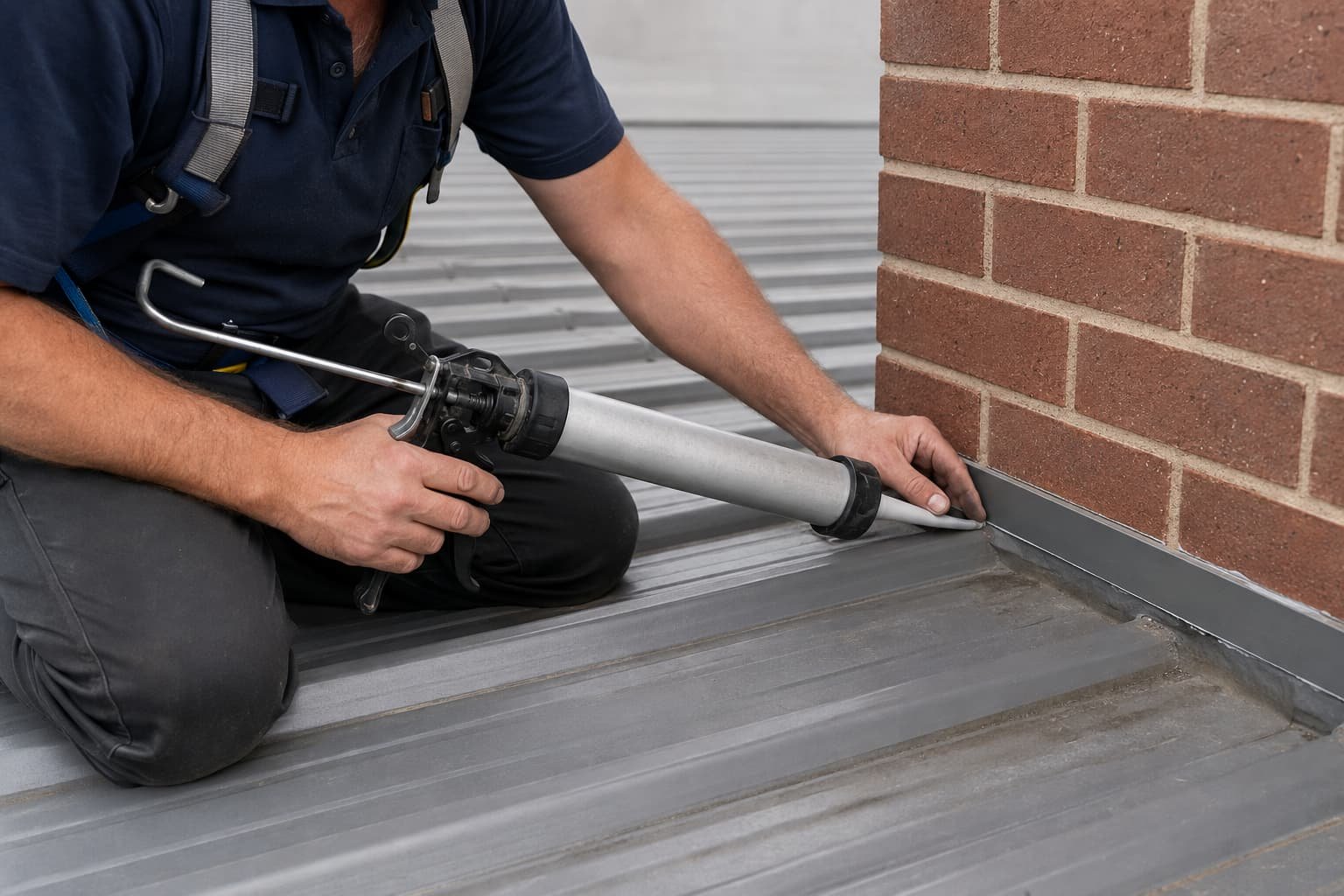
Roof Leak Repairs on the Gold Coast
Roof leak repairs are the most common call-out we take on the Gold Coast, and the reason is almost always the same: a small defect that sat quietly through the dry months and then failed the first time a proper storm cell came through. A leak rarely announces itself at the point where the water is getting in. By the time a stain shows on your ceiling, the water has usually travelled several metres along a batten or a rafter before finding somewhere to drop.
Why Gold Coast Roofs Leak
The local climate does a specific kind of damage. Summer storms arrive fast and hit hard, driving rain sideways under flashings and lapping it back up beneath tiles that would shed water perfectly well in a vertical downpour. Between November and March the Gold Coast regularly sees rainfall intensities that overwhelm valleys and box gutters designed for gentler conditions, and hail from inland cells cracks tiles that then leak on the next fall.
Salt is the second factor, and it reaches much further west than most homeowners expect. Fixings, flashings and valley irons on homes within a few kilometres of the coastline corrode faster than the sheeting they hold down, so the leak often starts at a fastener or a joint rather than in the roof material itself. On older Southport and Palm Beach stock, the original valley irons are frequently the first thing to go.
The third is age. A large share of Gold Coast housing was built through the 1970s to the 1990s, which puts thousands of roofs right at the point where bedding mortar has crumbled, sarking has perished or was never installed at all, and pointing along ridge capping has lost its flexibility and cracked away.
Our Roof Leak Repair Process
Finding the entry point matters more than the patch. A repair applied to the stain rather than the source is the single most common reason a leak comes back a fortnight later.
- Internal inspection. We start inside, in the roof cavity where possible, tracing the water back along timbers to where it is actually entering. Staining, rust marks on nail plates and damp insulation all point uphill towards the source.
- Roof survey. We then work the roof surface itself, checking flashings, penetrations, valleys, ridge capping, fasteners and any cracked or displaced tiles or sheets. Most leaks trace back to a junction rather than an open field of roofing.
- Repair. We fix the defect properly rather than sealing over it, whether that means replacing tiles, renewing a length of valley iron, re-bedding and repointing capping, or replacing perished fasteners and flashings.
- Verification. Where there is any doubt, we hose-test the repaired area and check the cavity again before we leave, so you are not waiting for the next storm to find out whether it worked.
What Roof Leak Repairs Cost on the Gold Coast
Prices below are indicative and include GST. A firm figure comes after inspection, because the cost of a leak depends almost entirely on what is behind it.
- Leak detection and inspection: $250 to $450, credited against the repair if you proceed with us.
- Minor flashing or penetration repair: $350 to $800 for resealing or replacing a single flashing, vent or skylight surround.
- Tile replacement and localised repointing: $600 to $1,500 depending on tile type, access and how much capping is involved.
- Valley iron replacement: $1,200 to $3,500 per valley, driven by length and whether tiles need lifting and resetting either side.
- Full ridge re-bedding and repointing: $1,800 to $4,500 for an average single-storey home.
- Emergency make-safe and tarping: $400 to $900 to stop water entry immediately when a permanent repair has to wait.
Two-storey homes, steep pitches and anything requiring scaffold or an elevated work platform will sit above these ranges. We tell you that before we quote, not after.
Frequently Asked Questions
How quickly can you attend a leaking roof?
Active leaks are prioritised, and we aim to attend the same day or the next during storm season. If a permanent repair is not possible immediately, we make the roof safe and watertight first and return to complete the work.
Can a roof leak be repaired while it is raining?
A temporary make-safe can be done in wet conditions. A permanent repair generally cannot, because sealants, bedding and pointing compounds need a dry substrate to bond properly. Anyone who tells you otherwise is selling you a repair that will fail.
Will my insurance cover the repair?
Sudden storm or impact damage is usually covered; gradual deterioration and lack of maintenance generally are not. We provide a written report with photographs that you can lodge with your insurer either way.
Do I need a licensed roofer for a small leak?
In Queensland, building work valued above $3,300 must be carried out by a licensed contractor, and roof tiling and roof plumbing are separate licence classes. You can check any licence number on the public register at the Queensland Building and Construction Commission before work starts.
Is it worth repairing an old roof or should it be replaced?
If the leak is isolated and the rest of the roof is sound, a repair is almost always the better value. Where a roof is failing in several places at once, repeated repairs stop making sense and a restoration or replacement is the more economical path.
Roof Leak Repairs Across the Gold Coast
We cover the full Gold Coast, from the Broadwater down to the southern beaches and west into the hinterland fringe, including Southport, Nerang, Burleigh Heads, Mudgeeraba, Robina and Upper Coomera.
Leaks are rarely the only thing we find once we are on a roof. If the inspection turns up wider problems, we will tell you plainly whether you are looking at storm damage repairs, tile roof repairs, metal and Colorbond repairs, blocked or failed gutters and valleys, or whether the roof has reached the point where restoration and repointing is the sensible investment.
Water that gets into a roof does not stay in the roof. It reaches insulation, ceiling linings, cornices and eventually wiring, and the cost of putting that right climbs steeply the longer it runs. If you have a stain on a ceiling, a damp patch after rain, or a drip you have been catching in a bucket, it is worth a look now rather than after the next storm.